How to make Intensive Green roofs?
Introduction
Intensive greening of a roof can be considered comparable to more traditional soft-landscaping schemes in terms of potential use and diversity of design. Planting can include lawn, shrubs, bushes and even the occasional tree. Once planted, the vegetation imposes a fairly high demand on the composition layers and needs regular irrigation (or a water retention system) as well as a regular supply of plant nutrients. This type of green roof can only thrive with regular maintenance. An intensive green roof can easily be combined with hard landscaping for pedestrians and vehicular traffic.
Due to the vegetation’s demands for water and nutrients, along with the planting itself, the typical minimum weight of this type of green roof would be around 282 kg/m2 with a minimal layer depth of 217 mm.
When designing intensive green roofs, these high loadings must be taken into consideration.
Features of an intensive green roof:
- wide choice of suitable vegetation
- total freedom of design
- easily combined with pedestrian and vehicle accessible areas
- construction height – starting from 217 mm
- dead load – starting from approx. 282 kg/m2
Design considerations
1.1 Standards
CE-marking hEN 13252
Geotextiles and geotextile-related products for use in drainage systems must bear a CE marking pursuant to the European Standard hEN 13252 ‘Geotextiles and geotextile-related products – Characteristics required for use in drainage systems’. Drainage systems are defined as systems that collect and transport precipitation, ground water and/or other liquids or gases via a geotextile or a geotextile-related product.
This European Standard covers more than just geotextiles such as filter membranes and filter fabrics. Geotextile-related products such as geocomposites (drainage channels and drainage panels) and geospacers (nubbed film and nubbed panels [so-called eggbox-shaped dimples]) are also covered by this standard (hEN ISO 10318 ‘Geosynthetics – Part 1: Terms and definitions’).
The manufacturer is responsible for issuing a Declaration of Performance (DoP) relating to the essential characteristics of the geotextiles and drainage channels that it has brought onto the market pursuant to the European Standard hEN 13252). Part of the Declaration of Performance is an internal production control system that is assessed annually by a certification institute (Notified Body). The product therefore satisfies the national provisions set by the European Member States with regard to the essential characteristics of construction products. All geotextiles and geotextile-related products brought onto the market by manufacturers have to bear the CE-marking.
FLL-Guideline for the Planning, Construction and Maintenance of Green Roofing, published 2008
There are no European standards which specify the design of green roofs. The FLL (a research institute in Germany) has drawn up a guide for the design, installation and maintenance of green roofs.
This guide sets out the basic principles and requirements that, in general, apply to the design, installation and maintenance of green roofs. This guide is based upon scientific research and practical experience in building green roofs in Germany over the past 20 years.
In many countries throughout Europe this document has been accepted as the key guide for building green roofs. This guide is also based upon this FLL-Green Roof Guideline.
1.2 Design loads
The structural deck should be able to withstand and to absorb the static and dynamic loads imposed during construction and final use.
The load on a roof is determined by the:
- dead permanent load imposed by the weight of the construction
- permanent load imposed by the composition of the green roof
- variable load due to e.g. maintenance work or traffic load
The assumed permanent load of an intensive green roof at maximum water capacity:

* Weight approx 1,5 tonne/m3 at maximum water capacity
** Optional for usage in a non-root resistant waterproofing membrane
There are no published standards governing the construction of elemental pavements over a roof deck in the UK or RoI. Through research in close cooperation with the Technical University in Munich, Germany, the following load classes can be distinguished based upon the intended use of the roof deck:

The construction of elemental pavements over roof decks for the various load classes is described in the section “Trafficable roofs”.
1.3 Roof constructions
The structural deck needs to be able to carry the extra load of the extensive green roof composition. The waterproofing membrane should be root resistant and as with the thermal insulation, be able to carry the permanent load of the extensive green roof composition.
The following roof constructions are recognized:
Cold roof construction
This is a roof construction with an independent ceiling enclosing an air space between the structural deck and the ceiling. When insulation is used it should be placed below the structural deck with a ventilated airspace in between. The load bearing capacity of the structural deck is generally minimal and must correspond to the calculated weight of the extensive green roof. The cooling effect of an extensive green roof can affect the physical properties of the structure. Freezing temperatures on the underside of the structural deck may result in frost damage to the vegetation.

Warm roof construction
This is a roof construction without a ventilated airspace beneath the structural deck. When insulation is used it should be placed on top of the structural deck. It is recommended that a vapour control layer be placed on top of the structural deck underneath the thermal insulation. In general, all types of green roof systems and all forms of vegetation are suitable for use with this type of roof construction.

Inverted roof construction
Insulation is placed on top of the waterproofing membrane. Should an inverted roof be selected for greening, moisture diffusion measures should be considered. When an extensive green roof is installed, a damp-permeable drainage layer must be placed over the thermal insulation in order to protect the insulation from accumulating moisture (internal condensation) over time.
In general, all types of green roof systems and all forms of vegetation are suitable for use with this type of roof provided there is sufficient dead load to prevent uplift of the thermal insulation due to water and wind.

Roof construction without thermal insulation
On top of the structural deck the waterproofing membrane is installed without any thermal insulation. A characteristic of this roof construction is that the space beneath the roof is not heated. Basically all types of green roof systems and all forms ofvegetation are suitable. Freezing temperatures on the underside of the structural deck may result in frost damage to the vegetation.

1.4 Thermal insulation
Thermal insulation needs to be CE-marked based upon the hEN 13162 – 13171 ”Thermal insulation products for buildings. Factory made … Specification”.
There are two different methods for installing thermal insulation to a roof deck:
- IRC = insulation placed above the waterproofing membrane – inverted roof construction
- WRC = insulation is placed beneath the waterproofing membrane – warm roof construction
A cold roof has been omitted as this type of roof construction is rarely used nowadays.

The waterproofing membrane and the applied thermal insulation should be able to withstand short and long term loadings. Should any deformations of the thermal insulation be expected, it should be taken into account when detailing the waterproofing membrane (roof outlet, roof edge, roof protrusion, etc.).
For load class 1, the roofs built on an insulated roof, the thermal insulation should meet minimum load class “dh”.
For load classes 2 and 3 the thermal insulation should meet load class “ds” respectively load class “dx”. The suitability of thermal insulation is to be demonstrated by the
manufacturer.
Recommendation
If a paving needs to be installed on top of an insulated roof, it is recommended that an inverted roof construction with XPS insulation or a warm roof construction with cellular glass be chosen. With an inverted roof the waterproofing membrane should be fully bonded with the structural deck, in order that any leak in the waterproofing membrane can be located easily. The XPS insulation panels offer extra protection of the waterproofing membrane during installation of the paving composition.
It is important that a damp-permeable drainage layer is placed on top of the XPS insulation. This allows the panels to dry. Water absorption due to internal condensation will be minimised. It is not necessary to install a separate vapour control layer as the waterproofing itself acts as one. The drainage layer should not damage the top of the insulation panels. Full bonding of the waterproofing membrane is also possible with a warm roof construction if cellular glass is used as thermal insulation. The cellular glass panels are fully bonded with the structural deck and all joints are filled with bitumen. The waterproofing system is thereby fully bonded with the cellular glass panels.
Suitability of the various types of thermal insulation:

* Compressive strength at 10 % deformation in accordance with hEN 826 “Thermal insulating products for building applications. Determination of compression behaviour”
1.5 Waterproofing systems
Continuous waterproofing systems
Roof constructions are, in general, protected against the penetration of water by a waterproofing system (bitumen, synthetic or liquid-applied).
When designing and choosing a waterproofing system, the intended use, applicable standards, regulations and standards of good practice have to be observed. Roof decks should be constructed with adequate falls.
The waterproofing system should be designed to suit the anticipated use. To maintain the integrity of the waterproofing membrane, and to ensure proper construction of the paving, it is essential that the membrane system is being laid as flat as possible.
On trafficked roof decks, horizontal loads caused by vehicle overrun can excessively compress the waterproofing membrane. Such loading should be avoided and therefore separation and slip layers should be built in to the structure.
The waterproofing membrane beneath any vegetation (intensive or extensive planting schemes) should be root resistant or protected against root penetration by a separate root barrier. Root resistance can be proven if the material has passed the FLL-root resistance test or is covered by the British Board of Agrément (BBA) Certification for green roof applications.
The membranes can be applied in one or two layers and attached to the structural deck according to the following methods:
- loose laid and ballasted
- mechanically fixed
- fully bonded.
The composition of a fully bonded waterproofing system can be as follows:
Bitumen – modified bitumen waterproofing membranes
(APP – SBS)
- at least two layers
- first layer: a polyester based roofing felt fully bonded to the structural deck (pour and roll)
- top layer: a root resistant APP or SBS waterproofing membrane fully bonded (torched).
Synthetic waterproofing membranes
- at least two layers
- first layer: a polyester based roofing felt fully bonded to the structural deck (pour and roll method)
- top layer: EPDM, ECB, POCB or TPO waterproofing membrane fully bonded to the first layer.
Liquid-applied roof waterproofing
- Liquid-applied roof waterproofing is regarded as a single layer system.
- It should adhere to the entire surface and be applied in at least two discrete layers.
- A suitable geotextile should be placed in between the layers as a reinforcement.
- The manufacturer should have European Technical Approval in accordance with ETAG 005 “Liquid Applied Roof Waterproofing Kits”.
Mastic asphalt
- The concrete sub-structure needs to be primed before nstallation.
- As a sub-layer – a root resistant APP – SBS torch-on embrane.
- The asphalt layer with a minimum thickness of 25 mm should be installed on top of the sub-base.
Water-resistant concrete
- Requirements for water-resistant concrete are specified in hEN 206-1 “Concrete. Specification, performance, production and conformity ”and hEN 8500 “Concrete – Complementary British Standard to hEN 206–1 Parts 1 and 2”.
- Cracks in any direction should be limited to ≤ 0.2 mm.
Recommendation
It is recommended that a waterproofing membrane is fully bonded with the structural deck. In many installations leakages occur due to incorrect detailing, poor choice of materials or errors/damage incurred during installation. When a loose laid waterproofing system is damaged, the point of leakage is difficult to locate as the water can move freely over the structural deck. Fully bonded waterproofing systems give much more security if they are installed on a closed structural deck. This means that with insulated roof constructions the choice is limited to a warm roof with cellular glass or PUR and an inverted roof with XPS insulation.
If it has been decided to install a warm roof construction in which the waterproofing membrane is not fully bonded with the structural deck, it is recommended that separate compartments within the vapour control layer be created. In case of any damage to the waterproofing membrane, any leak can be located more easily.
1.6 Details
Basically, the same waterproofing detail principles apply to green roofs as to flat roofs. The waterproofing membrane should be brought up above the surface level by at least 150 mm at roof upstand details e.g. parapets, abutments, and roof protrusions.
Roof edge
At roof edge details a clear strip of clean gravel (min. 16/32 mm) or concrete slabs should be installed for maintenance and inspection purposes. The minimum recommended width is 300 mm. To prevent the growing medium being washed into the clear strip, an Edge Retaining Profile should be installed.
If the waterproofing membrane projects over the roof edge into the ground, it is recommended that the waterproofing membrane extends a minimum 500 mm beyond the edge and at least 200 mm over a joint.


Facade
At facades, the waterproofing membrane should be brought up above the highest roof edge by a minimum of a 150 mm above service level. This is not always possible at door thresholds, therefore at those door thresholds where a channel drain is installed, the waterproofing membrane can be brought up above the surface level by 50 mm.
Along facades, a clear strip of clean gravel (min. 16/32 mm) or concrete slabs should be installed for maintenance and inspection purposes, and to act as a splashguard. The clear strip between the facade and the vegetated area helps to prevent any water run-off adversely affecting the development of the plants. To prevent the growing medium being washed into the clear strip, an Edge Retaining Profile should be installed.
The minimum recommended width of this clear strip is 300 mm.


Roof protrusion with or without roof upstand
The roof upstand of e.g. roof lights, ventilation shafts and other roof protrusions must be at least 50 mm higher than the roof edge or the emergency overflow. The waterproofing membrane must be brought up to a minimum of 150 mm above service level.
Around roof protrusions with or without a roof upstand, a clear strip of clean gravel or concrete slabs should be installed for maintenance and inspection purposes. To prevent the growing medium being washed into the clear strip, ab Edge Retaining Profile should be installed. The minimum recommended width of this clear strip is 300 mm.
Roof outlet
Where a roof outlet is positioned within a vegetated area, an inspection chamber complete with access cover is placed over the outlet to protect it from plant growth and impurities. The inspection chamber should not affect or impede drainage efficiency and must be accessible at all times.
A clear strip of clean gravel (min. 16 – 32 mm) should be placed around the inspection chamber. The recommended width of this clear strip should be a minimum of 300 mm. To prevent the growing medium being washed into the clear strip, an Edge Retaining Profile should be installed.
Roof outlets lying outside the vegetation area are normally positioned within a gravelled area, with a gravel guard covering the outlet. When a roof outlet is located within a hard-landscaped area, an inspection chamber fitted with a suitable grating should be placed over the outlet.


1.7 Design of falls – roof slope
For an intensive green roof, falls should ensure that no water is allowed to pond on the roof construction. The construction should be such that any accumulated water or ponding is prevented from coming into direct contact with the growing medium layer at any time.
In order to achieve this, flat roofs should be constructed to a minimum fall of 1 in 80 (~1.3 %). This means that the design fall should be greater to take in to account deflections and inaccuracies in construction. Some designers take a fall of 1 in 80 (~1.3 %) and add an arbitrary adjustment for construction inaccuracies of 25 mm for concrete roofs and 15 mm for metal decks.
It should be noted that water might pond on the roof covering even though the roof was designed with sufficient falls. This may be due to overlaps of the waterproofing membrane, or unexpected inaccuracies in construction, or deflection of the roof construction.
Consequently, where the growing medium has direct contact with standing water, the growing medium will become saturated due to capillary action. A healthy growing environment for the plants cannot be guaranteed in such circumstances. By using Drainage Systems with a construction height of 27 mm, direct contact of standing water and the growing medium can be avoided.
Roofs with a fall ratio of 1 in 20 or more (≥ 5 %) should have an increased water retention capacity as such relatively steep falls can result in accelerated and / or excessive water removal from the growing medium. This is achieved by increasing the depth of the growing medium layer.
1.8 Designing for stormwater
Roof drainage
hEN 12056-3 ”Gravity Drainage Systems inside buildings. Roof drainage, layout and calculation” provides for a run-off coefficient to allow for absorbent roofing surfaces where national and local regulations, and practice, permit.
For roofs with a fall of 1 in 40 (2.5 %) or flatter (nominally flat roofs) the designer should use a hEN 12056-3 Category 1 storm event for design purposes. This storm event will occur on average once per year and will generate rainfall intensities which vary from 0.01 l/(s.m2) to 0.022 l/(s.m2) depending on geographical location. This is very short duration thunderstorm rain, and will occur on average for 2 minutes, usually in summer, when a green roof composition could be expected to be at its driest.
In using this method, it is assumed that any storm greater than this intensity would be absorbed into the green roof composition, or would pond on any hard surfacing between green areas. The roof deck should however be strong enough to resist the loads imposed by minor ponding, as it should have been designed to cope with the loadings from the green roof.
For roof falls greater than 1 in 40 (2.5 %), a hEN 12056-3 Category 2 or 3 storm event should be used, as there is a risk of structurally significant ponding in the event of the green roof area not be capable of absorbing all the stormwater. Category 2 and 3 storm events are based on the building life multiplied by a factor of safety of 1.5 or 4.5, and results in much higher rainfall intensities (0.029 l/(s.m2) to 0.088 l/(s.m2)).
Run-off coefficients
For intensive green roofs, the following water run-off coefficients (C) can be used. The values depend on the depth of the growing medium and the roof slope:

Annual stormwater retention capacity
The annual average percentage of stormwater actually retained by a green roof is calculated as the difference between the amount of rainfall and the amount of water discharged. The inverse of this is the annual run-off coefficient, Ca. The annual stormwater retention depends more on the depth of the growing medium layer than on the type of composition and composition of the layers.
The annual average percentage of stormwater retention and the run-off coefficient of a green roof system at various construction heights, assuming an annual precipitation rate of 650 – 800 mm:

At a higher (> 800 mm) or lower (< 650 mm) annual precipitation rate the annual average stormwater retention will be lower or higher as stated in table 7.
1.9 Fall protection
On flat roofs, all necessary safety measures required for use of the roof by the public, carrying out inspection and maintenance work should be considered at the planning stage. Planning for adequate safety precautions at the design stage eliminates potentially higher costs that may be incurred should fall protection safety measures need to be installed at a later date.
Collective preventive measures, e.g. guard-rails, toe-boards, barriers, etc., should be installed. Personal fall protection equipment is not suitable for an intensive green roof as this type of green roof is designed to be accessible to the public.
1.10 Fire prevention
Properly maintained intensive green roofs are classified as “hard roofs” and as such, are regarded as resistant to flying sparks and radiating heat.
1.11 Wind loads
Waterproofing membranes and green roof layers have to be designed to take into account wind loads. It is the engineer’s responsibility to determine the appropriate dead loads and the position thereof. It should be noted that the potential for wind uplift is greatest at the roof perimeters and so protective measures, such as gravel strips or concrete slabs, may be required.
Where waterproofing membranes are laid loose without being permanently fixed to the deck structure, the green roof layers may act as a ballast. The determining factor will be the dry weight of these layers.
In addition, the following is to be taken into consideration:
- the variable height, thickness and density of the vegetation
- the load of residual moisture in the layer structure
- the load of the vegetation
- the weight of the vegetation
- The open, airy nature of the planting that reduces the wind uplift of the vegetation layer.
These criteria are to be included in the design wind loads calculations.
1.12 Protection from emissions
The plants may be subjected to dehydration and frost damage due to exposure to excessive warmth, cold air and / or air currents caused by ventilation systems and air conditioning. Further, gases from chimneys and exhaust systems can cause direct damage to the vegetation. A clear strip, the area/width depending on the effect of the emission, is to be observed.
1.13 Design features
Some design features that could be included in an intensive green roof are:
- fences
- pergolas and arbours
- lamps and lighting
- ponds, rills, fountains and other water features
- benches, seating, tables, etc.
The installation and construction of design features often require object-specific detail solutions which are determined by considering their construction, the static and dynamic loads they may impose, and their physical properties.
The structural stability, weight distribution, and anchorage must be secure at all times. Stresses on the protection and drainage layers should be prevented at all times. During the design process, surface loads and stress points as well as wind stress should be considered.
1.14 Protection from calcium deposits
Carbonates released from the protection layers (i.e. cement or concrete floor screeds, plant borders, covers or design features) may cause damage to the roof drainage system.
Note:
These layers should be densely formed or treated in such a way to minimise the amount of carbonate discharge. Alternatively one could choose for different materials such as metal or plastic edge retaining profiles made out of plastic or metal.
1.15 Maintenance
It is recommended that a maintenance contract be drawn up between the owner and contractor involving a long-term care plan.
The care plan should, naturally, cover essential maintenance of the plants, but it is essential that the following points are also considered:
- functionality of the drainage system and the inspection chambers for the drainage / irrigation system
- inspection for impurities, deposits and root growth in the inspection chambers
- stability of plant borders, surface fasteners and other components to make sure they are in good condition to maintain the integrity of the green roof
- inspection of the waterproofing system on damages.
2 The composition of an extensive green roof
2.1 Composition
The composition of an intensive green roof comprises the following layers that are considered in subsequent sections:
- root barrier layer
- separation and slip layer
- protection layer
- drainage layer
- filter layer
- water retention layer
- growing medium layer
- vegetation layer.
The various layers need to be geared in such away that the functionality of the total composition is guaranteed. Each layer has a specific function in the green roof system composition. It is possible that one product integrates the functions of several layers or that one layer consists of more than one product e.g. the drainage systems integrate the drainage and filter layer and in certain compositions, also include the separation and protection layer.
Multi-layer green roof composition
An intensive green roof system is a multi-layered construction comprising of a number of individual layers each with its own function. Within the construction, the growing medium is separated from the drainage layer by a filter fabric. The filter fabric prevents finer particles from the growing medium entering the drainage layer. This filtration ensures that a fully functional horizontal and vertical drainage is maintained at all times.
As the growing medium layer does not function as a horizontal drainage component it can be mixed with organic-based material to improve moisture retention and nutrient supply, thereby increasing the buffering action and simultaneously improving plant growth.
Advantages of a multi-layer system:
- enhanced moisture-retention of the growing medium promotes healthy plants over the longer term
- excellent long-term horizontal and vertical drainage preventing additional dead loads on the roof structure caused by rainwater ponding
- good buffering action in the growing medium provided by the presence of both finer particles and organic.
2.2 Root barrier layer
The root barrier layer prevents the ingress of roots into the waterproofing layer. The root barrier layer can be integrated in a root resistant waterproofing membrane e.g. PVC, EPDM or bitumen-copper waterproofing membranes tested in accordance with a root resistance test.
If the waterproofing membrane is not root resistant, a separate root barrier should be placed directly on top of the waterproofing membrane. Overlaps have to be heat-welded along the lapped joints. Use of a separate root barrier on top of the waterproofing membrane is not required in those situations where the waterproofing membrane is root resistant.
Note
For the installation of a separate root barrier the same detail principles apply as for the installation of a waterproofing membrane. On inverted roof constructions lacking a root-resistant waterproofing membrane, the root barrier is positioned directly beneath the thermal insulation and on top of the waterproofing membrane.
2.3 Separation and slip layer
The separation layer separates materials that are chemically incompatible (e.g. Polyvinyl Chloride (PVC) and Polystyrene (PS)).
The separation layer can also act as a part of the slip layer. The Drainage Systems are available with pressure dividing slip film or separating geotextile to suit individual applications.
No forces are to be passed on to the waterproofing system by the overlying installed layers. Should such forces occur as a result of the intended use, a slip layer must be installed. A slip layer consists of two smooth surfaces installed over the waterproofing system.
In the Green Roof Systems, the slip layer is formed by using the Slip and Protection Sheet or Separation and Slip Film and the Drainage Systems.
2.4 Protection layer
The protection layer guards the waterproofing membrane against mechanical and dynamic loadings. When using a separate protection layer, this should be a protective membrane, a rubber mat with a thickness of 4 or 6mm), or a geotextile with a minimum weight of 300 g/m², a minimum thickness of 2 mm and a puncture resistance of 1.5 kN. The protection layer should be designed to suit the conditions to which the waterproofing membrane will be subjected. The protection layer can also fulfill the function of the separation layer and form part of the slip layer.
If Drainage Systems are fitted immediately after installation of the waterproofing membrane, they can act as a separation and protection layer for lightweight static loads such as an intensive green roof. At heavier loadings, heavy geotextiles, plastic sheets, concrete layers, and the like are needed to guard the waterproofing membrane against damage from static and dynamic loads occurring during installation and when in use.
Recommendation
On roofs of load class 1. (podium roof decks), load class 2. and load class 3. (trafficked roof decks) where a levelling layer or sub-base is installed, or when wheeled loaders are used during installation of the growing medium on a green roof, it is recommended to install a Slip and Protection Sheet above the waterproofing system. The Slip and Protection Sheet should be installed in such a way that no granular material can get underneath and damage the waterproofing membrane.
2.5 Drainage layer
The drainage layer relieves the waterproofing membrane of hydrostatic pressure. In addition, any excess water in the growing medium layer is led away, preventing potential ponding of water in the growing medium that may damage the vegetation. The drainage layer must have a good vertical permeability combined with the ability to transport excess water horizontally away from the roof area. It must maintain full functionality for a period of 50 years, in compliance with DIN 4095 ”Drainage and protection of sub-structures – design, dimensioning and installation”.
The drainage capacity should be specified in l/(s.m) taking into account the roof slope/pitch and the expected load pressure. Any Drainage System including eggbox-shaped dimpled plastic sheets (geospacers), that forms part of a drainage system must be CE-marked, hEN 13252.
2.6 Filter layer
It is essential that the drainage layer should be permanently protected against clogging by fine particles present in the growing medium. This is achieved by using a woven or a non-woven filter fabric to retain these fine particles. The weight of this geotextile is normally 100 – 200 g/m2, depending on load, and the pore size should correspond to the minimum particle size of the growing medium. In general, the geotextile should have a puncture strength of 0.06 mm – and a pore opening size of 090 < 0,2 mm. The filter layer should allow roots to grow through into the drainage layer.
Note
The woven / non-woven filter fabrics must overlap by at least 100 mm. In situations where the filter layer (geotextile) as part of a drainage system is placed on top of an eggbox-shaped dimpled plastic sheet (geospacer) or a granular material, the geotextile as well as the geospacer must be CE-marked (hEN 13252).
2.7 Drainage Systems
Drainage Systems comprise the filter layer, the drainage layer, protection layer (lightweight static loads) and the separation and slip layer as one integrated unit. The Construction height of the Drainage System is between 13 and 27 mm. A filter fabric (woven or non-woven) is bonded to each dimple. Depending on the application, the core may be perforated and provided with a plastic film or a geotextile on the back. The dimples of the Drainage System act as an additional water reservoir for the vegetation.
Drainage Systems on inverted roof constructions
The Drainage Systems have a perforated core. These Drainage Systems prevent the formation of a vapour control layer on top of the XPS thermal insulation. The top of the XPS insulation panels can dry out and therefore internal condensation is minimised. The insulation value over time is not affected.
Dimensioning Drainage Systems
The amount of water that needs to be discharged by the drainage layer (q’) can be calculated per l/(s.m) by using the following equation:
q’ = A x Cs x r / Lr, in l/(s.m)
q’ = required amount of water to be discharged by the drainage
layer l/(s.m)
A = effective roof area m2 (Lr x Br)
Cs = run-off coefficient (see table 6)
r = rainfall intensity l/(s.m2)
Lr = length of the roof to be drained m

Lr = the length of roof to be drained
Br = the plan width of roof from gutter to ridge
Hr = the height of roof from gutter to ridge
Tr = the distance from gutter to ridge measured along the roof
2.8 Water retention (reservoir) layer
Intensive green roof planting generally has a large surface area that results in high levels of transpiration and there is, therefore, a high demand for water. A system of irrigation-on-demand is unlikely to be successful, because, by the time the need for water has been recognized (i.e. by the wilting of the plants), damage has already occurred. Water retained by the mineral and organic content of the growing medium is only partly accessible to the plants. In order to meet the plants’ need for water, the depth of the growing medium layer needs to be increased, which thereby increases the loading on the deck structure.
An alternative strategy is to provide irrigation of the growing medium through moisture diffusion by the evaporation of stored water on the structural deck, or through the evaporation of water stored in plastic Drainage Systems (e.g. in the eggbox-shaped dimpled sheets). The disadvantage of relying on moisture diffusion is that the stored water is not in direct contact with the growing medium, and consequently water is not available on demand for the planting by means of capillary action.
By installing Water Reservoir Panels, up to 40 litres of water per square metre can be retained naturally, similar to the manner in which clay or sub-soils retain water. Water is transported by direct contact of the water reservoir panels with the growing medium. The growing medium itself will not become oversaturated because the retained water is restricted to the lower 40 mm of the 50 mm thick water reservoir panels and is only transported to the upper area by capillary action when needed.
Through direct contact of the water reservoir panels with the growing medium, the vegetation is able to regulate its own water balance, as nature intended. When the water reservoir panels become saturated, surplus water is discharged into the drainage layer. By using the ND WSM-50 Water Reservoir Panels there is no composition of hydrostatic pressure against the waterproofing membrane.
The Water Reservoir Panels are manufactured from hydrophilic mineral wool. Long-term stability is achieved due to the high density (120 kg/m3). The panels have a water retention capacity of 40 l/m2 at a construction height of only 50 mm. Due to the limited amount of compressibility, the panels have to be approved as a substrate substitute by the FLL-Green Roof Guideline.
2.9 Growing medium layer
The composition of the growing medium is important for the health and growth of the plants. It needs to be capable of retaining water, making sufficient quantities of water accessible to the plants whilst allowing any water surplus to be discharged to the drainage layer.
Substrate
The growing medium consisting of granular material contains a very low proportion of organic material (≤90 g/l). The FLL-Green Roof Guideline has defined the exact requirements of such a substrate. The organic content improves moisture retention and nutrient supply, thereby increasing the buffering action and simultaneously improving plant growth. The high mineral content prevents clogging of the drainage and the filter layer by small fine particles.
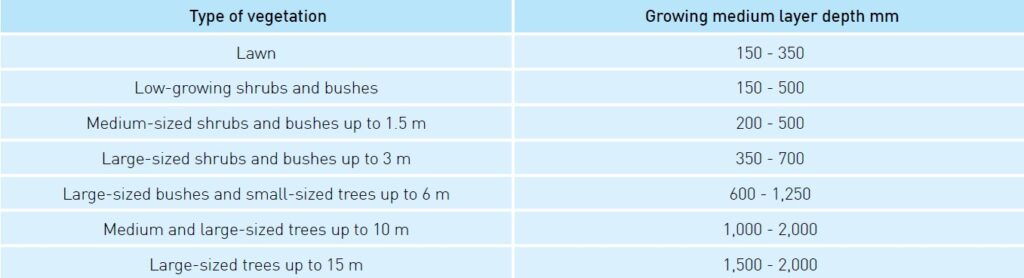
The depth of the substrate varies between 150 mm and 2,000 mm, depending on the type of vegetation selected. When the substrate a depth of approx. 350 mm, it will be necessary to reduce the organic matter content. At depths greater than 500 mm, a pure, mineral-based substrate should be installed beneath the intensive substrate layer. Because the substrate has little water retaining capacity due to the high mineral content, Water Reservoir Panels should be installed.
Topsoil
Even though topsoil is a much better growing medium for intensive planting schemes than a manufactured substrate, it is not often used because the high organic content causes reduced filter stability. Over time, small organic fines will clog the drainage layer and the filter layer. Research shows that the use of topsoil in combination with the Water Reservoir Panels is possible. However, it is important that a soil analysis is undertaken to determine the suitability of the available topsoil. Based upon research, soil analyses and extensive testing, it can advised if it is possible to use a particular topsoil with the Intensive Green Roof Systems.
Some Water Reservoir Panels not only act as a 40 l/m2 water reservoir but also as an additional filter to prevent clogging of the drainage layer and filter layer.
The use of topsoil offers a considerable cost saving compared to an expensive substrate, which often has to be imported. Furthermore soil excavated on-site may be reused as a growing medium layer for an intensive green roof.
Foamed glass
Foamed glass makes it possible to create structurally stable banks and slopes on a roof with a minimum dead load. The specific weight of this material is only 150-350 kg/m3 (depending on the particle size and the method of compaction). The use of foamed glass offers landscape architects maximum flexibility in their designs.
The depth of the growing medium is determined by the vegetation’s requirements for water, nutrients and root space:
Delivery of Substrate can be done in big bags or loose.
The most appropriate form of delivery is determined by the size and location of the project. There may be losses of approx. 15-20 % due to settlement.
2.10 Vegetation layer
An intensive green roof may include one or more of the following vegetation communities:
- lawn
- low-growing shrubs and bushes
- medium-sized shrubs and bushes up to 1.5 m
- large-sized shrubs and bushes up to 3 m
- large-sized bushes and small-sized trees up to 6 m
- medium and large-sized trees up to 10 m
- large-sized trees up to 15 m
- bulbous plants.
The structure and specification of the roof determine the most appropriate selection of plants. Careful planning taking in to account the structural, climatic and vegetation aspects determine the success of an intensive green roof.
To be continued.
Intensive green roofs combined with hard landscaping
Intensive Green Roof Systems:
Roof with sufficient fall 1 in 80 to 5°
Roof with insufficient fall < 1 in 80